Removing financial barriers to care
- My Role
- Senior Product Design
- Collaborators
- Design, Product, Tech, Board
- 2023

Background & Objective
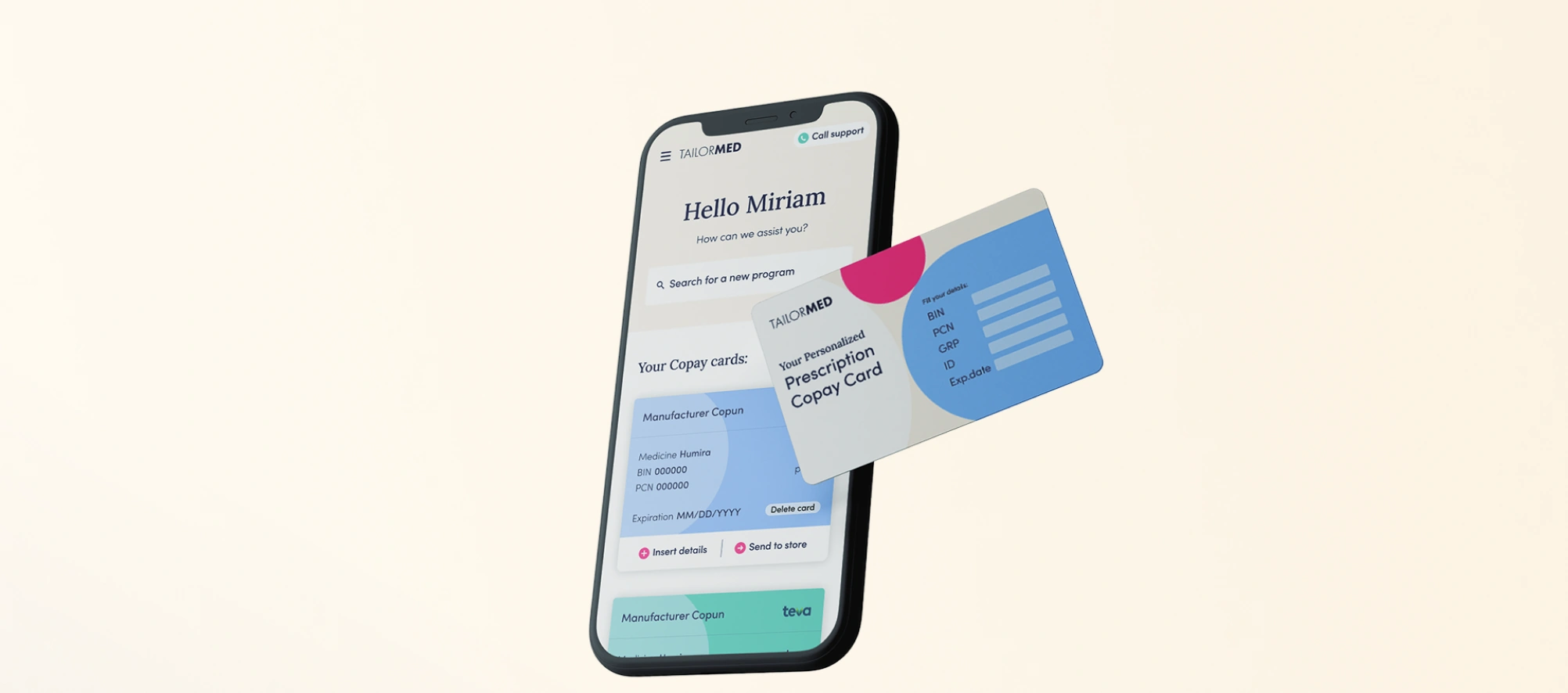
TailorMed is a healthcare technology company specializing in patient financial navigation. Before the redesign, 68% of eligible patients never completed the enrollment process for financial assistance programs, resulting in $2.4B in unclaimed aid annually across partner networks.
The Brief:
Define and validate a new experience framework that reduces drop-off rates, improves program enrollment, and scales across retail pharmacy partners.
Key Challenges:
Define and validate a new experience framework that reduces drop-off rates, improves program enrollment, and scales across retail pharmacy partners.
Trust
Pre-launch data revealed an average time spent by users of 11.2 minutes on the enrollment flow with 43% drop offs at the verification step, citing confusion and lack of trust.
Parity
Pre-launch flow had a 52% failure rate on different devices due to inconsistent breakpoints
Partners
Partner co-branding requirements led to 14 distinct visual configurations. Before redesign, brand compliance audits flagged 37% of partner instances for guideline violations.

The problem in numbers
Reduce a 68% abandonment rate and help patients access $2.4B in unclaimed financial assistance
Design Solution & Impact
Before
Post-launch analysis showed a 41% reduction in average completion time (from 11.2 to 6.6 minutes). We redesigned the eligibility step with progressive disclosure and trust signals — reducing that step's drop-off from 43% to 18%. Overall enrollment conversion improved from 32% to 61%, representing an estimated $780M in additional accessed aid across the first year.
After
The new design system reduced kiosk failure rates from 52% to 8% and cut partner onboarding time from 6 weeks to 9 days. Brand compliance violations dropped from 37% to under 3%. A/B testing across Walmart and Walgreens locations showed a 29% lift in completed enrollments versus the legacy flow.
Impact
Net Promoter Score among patients rose from 22 to 67 post-launch. Healthcare providers reported a 35% reduction in support calls related to financial navigation, freeing staff to focus on clinical care.